

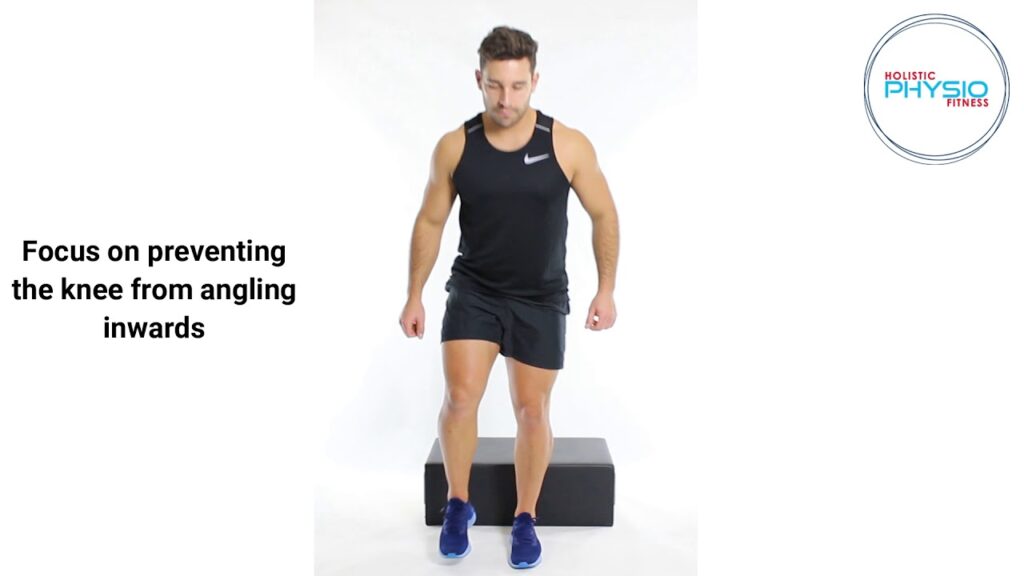
Knee pain when going down stairs is commonly associated with irritation around the kneecap, reduced strength or control of the muscles supporting the knee, osteoarthritis, tendon problems or a recent increase in activity. Walking downstairs places different demands on your knee than walking on level ground because your thigh muscles must control your body as it lowers onto the next step. If the knee is not currently coping well with that load, pain can develop around, behind or below the kneecap.
The good news is that knee pain on stairs does not automatically mean your knee is damaged or that you need to stop being active. In many cases, an appropriate combination of load management, progressive strengthening and physiotherapy can reduce pain and restore confidence.
Why Does My Knee Hurt When I Walk Downstairs?
Walking downstairs is essentially a series of controlled single-leg lowering movements. Your quadriceps—the muscles at the front of your thigh—must work to control the bending of your knee and prevent you from dropping onto the next step.
This increases the demand placed on the knee and kneecap. If your knee has recently been overloaded, has lost strength or is sensitive because of an underlying condition, stairs may expose the problem before ordinary walking does.
This is also why some people can walk comfortably on flat ground but experience pain when:
- Walking downstairs
- Squatting or lunging
- Getting out of a chair
- Walking downhill
- Running
- Kneeling
- Sitting with their knees bent for a long time
The activity that causes your pain provides useful information, but it does not provide a diagnosis by itself. Several different knee conditions can produce similar symptoms, so a proper assessment is important when the pain persists.
Common Causes of Knee Pain on Stairs
1. Patellofemoral Pain
Patellofemoral pain is one of the most common causes of pain around or behind the kneecap. It is sometimes called anterior knee pain or “runner’s knee”, although you do not need to be a runner to experience it.
Symptoms commonly develop gradually and may be aggravated by stairs, squatting, running, jumping or prolonged sitting. Rather than having one simple cause, patellofemoral pain may be influenced by several factors, including:
- A rapid increase in walking, running or training
- Reduced quadriceps or hip strength
- Changes in lower-limb movement and control
- Insufficient recovery between activities
- Returning to exercise too quickly
- A previous knee injury
- The knee’s current tolerance to load
Modern treatment does not simply focus on “realigning” the kneecap. Current best-practice guidance recommends understanding the individual factors contributing to the problem and using education with targeted knee and, where appropriate, hip exercises as the foundation of treatment.
2. Knee Osteoarthritis
Knee osteoarthritis can cause pain, stiffness, swelling and reduced confidence when using stairs. Symptoms may be worse after rest, first thing in the morning, after longer periods of activity or when repeatedly bending and loading the knee.
An osteoarthritis diagnosis does not mean exercise is unsafe or that joint replacement is inevitable. Exercise is recommended as a core treatment for knee osteoarthritis across major clinical guidelines, regardless of age, current pain levels or the severity seen on imaging.
The correct exercise program can improve strength, physical function and the knee’s capacity to tolerate everyday activities. The starting point and rate of progression should be matched to the individual.
3. Patellar Tendinopathy
The patellar tendon connects the kneecap to the shin bone. Pain from this tendon is usually felt just below the kneecap and may be aggravated by jumping, running, squatting and stairs.
Patellar tendinopathy is more common in active people and sports involving repeated jumping or rapid changes of direction. However, it may also develop after a sudden increase in exercise or activity.
Treatment commonly involves modifying aggravating loads temporarily and gradually rebuilding the tendon’s capacity through appropriately progressed resistance exercise.
4. Meniscal or Other Joint Irritation
The menisci are structures within the knee that help distribute load. A meniscal problem may follow a twisting injury or develop gradually alongside age-related changes in the knee.
Symptoms can include pain along the knee’s joint line, swelling, catching or difficulty fully bending or straightening the knee. Importantly, findings on a scan do not always explain a person’s pain. Assessment should consider your symptoms, strength, movement, function and medical history—not just an imaging report.
5. A Recent Increase in Activity
Sometimes the issue is not a specific injury. The knee may simply have been asked to do much more than it was prepared for.
Common examples include:
- Starting a new gym program
- Suddenly increasing running distance
- Adding hills or stairs to regular walks
- Returning to sport after a break
- Increasing squat or lunge volume
- Travelling and doing much more walking than usual
- Restarting exercise after illness or injury
In these situations, the problem may reflect a mismatch between current capacity and recent demand. Completely avoiding movement is not always necessary. A better approach may be to adjust the load and then rebuild capacity progressively.
Why Is Going Downstairs Often Worse Than Going Upstairs?
When you walk upstairs, your muscles work to lift your body. When you walk downstairs, they must control your body as gravity pulls it towards the next step.
This controlled lowering requires significant work from the quadriceps while the knee is bent. It can therefore expose reduced strength, poor control or sensitivity around the kneecap.
People often try to compensate by turning sideways, keeping the painful knee straight or relying heavily on the handrail. These strategies may be useful temporarily, but persistent difficulty suggests the underlying problem should be assessed.
Should I Stop Using Stairs?
Not necessarily.
If stairs are causing mild, manageable discomfort that settles shortly afterwards and is not progressively worsening, complete avoidance may not be required. You may temporarily reduce the number of trips, use the handrail or move more slowly while improving the knee’s capacity.
However, repeatedly forcing the knee through severe pain is unlikely to be helpful. The appropriate level of activity depends on:
- The cause of your symptoms
- How severe the pain is
- Whether swelling is present
- How long symptoms last after activity
- Whether the knee is improving or worsening
- Your current strength and function
- Your normal work, sport and exercise demands
A physiotherapist can help you determine what to continue, what to modify temporarily and how to progress safely.
What Exercises Help Knee Pain on Stairs?
There is no single exercise that is right for every painful knee. A rehabilitation program may include exercises for the quadriceps, hips, calves and the wider lower limb.
Depending on your assessment, exercises may include:
- Isometric quadriceps exercises
- Supported squats
- Sit-to-stand exercises
- Step-ups
- Controlled step-downs
- Split squats or lunges
- Knee-extension exercises
- Hip strengthening
- Calf strengthening
- Balance and single-leg control exercises
The exercise itself is only one part of the prescription. The resistance, repetitions, range of movement, frequency and rate of progression all matter.
An exercise that initially aggravates your knee may become appropriate later in rehabilitation. Conversely, an exercise commonly recommended online may be unsuitable for your current symptoms. This is why an individual assessment and progressive plan are more useful than following a generic list of “best knee exercises”.
Does Knee Pain Mean I Need an MRI?
Not always.
Many cases of knee pain can initially be assessed using your history, symptoms and a physical examination. Imaging may be appropriate when there has been significant trauma, serious injury is suspected, symptoms are unusual, the knee is genuinely locked, or the result would change your treatment.
Scans can also identify changes that are common in people without knee pain. An MRI finding therefore needs to be interpreted alongside your symptoms and physical assessment rather than treated as the whole diagnosis.
Your physiotherapist or GP can advise whether imaging or further medical investigation is appropriate.
How Can Physiotherapy Help?
Physiotherapy for knee pain should do more than provide temporary relief. A thorough approach aims to identify why the knee is painful, restore the abilities you have lost and improve its capacity for future activity.
Your assessment may include:
- The history and location of your symptoms
- Recent changes in activity or training
- Knee movement and swelling
- Quadriceps, hip and calf strength
- Balance and single-leg control
- Squatting and stepping technique
- Walking or running mechanics where relevant
- Your work, sport and everyday requirements
Treatment may combine education, activity modification, progressive exercise therapy and selected short-term strategies for symptom relief. Taping, manual therapy or other supportive treatments may sometimes help, but they generally work best as additions to an active rehabilitation program rather than replacements for it.
At Holistic Physio Fitness, our Mona Vale clinic combines private physiotherapy consulting rooms with a fully equipped rehabilitation gym. This allows treatment to progress from the initial assessment and symptom-management stage through to meaningful strength training, rehabilitation and return to normal activity.
When Should I Have My Knee Assessed?
Consider arranging an assessment if:
- The pain has persisted for more than a few days
- It is limiting stairs, walking, work, exercise or sport
- The symptoms are becoming more frequent
- The knee repeatedly swells
- You have lost strength or confidence in the leg
- The knee gives way, catches or locks
- You are unsure which exercises are safe
- The problem improves temporarily but keeps returning
Earlier assessment can help identify aggravating factors and prevent weeks or months of unnecessary avoidance.
When Is Knee Pain Urgent?
Seek urgent medical care if:
- You cannot place weight through the leg
- The knee is badly swollen or has changed shape
- The pain followed a major accident or injury
- The knee is hot, red and swollen, particularly if you also have a fever
- You cannot move the knee
- You experience rapidly worsening pain or swelling
These symptoms may require medical investigation rather than routine physiotherapy management.
Frequently Asked Questions
What is the most common reason for knee pain when going downstairs?
Pain around or behind the kneecap is commonly associated with patellofemoral pain, but osteoarthritis, tendon problems, meniscal irritation and recent overload can produce similar symptoms. The location of pain alone cannot confirm the diagnosis.
Why does my knee hurt downstairs but not when walking?
Walking downstairs requires the thigh muscles to control your body as the knee bends under load. This is generally more demanding than level walking and can reveal sensitivity or reduced capacity that is not noticeable on flat ground.
Is walking good for knee pain?
Walking can be beneficial, but the appropriate amount depends on your symptoms. If longer or hillier walks cause a substantial flare-up, the distance or terrain may need to be modified temporarily while strength and capacity are rebuilt.
Should I exercise if I have knee pain?
In many cases, appropriately selected exercise is an important part of recovery. The exercise should be matched to the likely condition, current symptoms and physical capacity. Severe pain, major swelling or an inability to bear weight should be medically assessed.
Can weak muscles cause knee pain on stairs?
Reduced strength or control in the quadriceps, hips or calves may contribute to difficulty tolerating stairs. However, weakness is only one possible factor, so assessment should also consider recent activity, symptoms, movement and any injury history.
How long does knee pain take to improve?
Recovery time varies according to the cause, duration of symptoms, current physical capacity and consistency with rehabilitation. Some people improve within several weeks, while longstanding problems may require a longer period of progressive exercise and load management.
Take the Next Step Towards Stronger, More Comfortable Knees
If knee pain is making stairs, walking, training or everyday life more difficult, you do not have to wait until it becomes severe.
The physiotherapists at Holistic Physio Fitness can assess your knee, explain the likely cause and develop an individual treatment and rehabilitation plan. Our Mona Vale clinic provides both hands-on physiotherapy and access to a fully equipped rehabilitation gym, allowing us to support you from pain management through to strength, confidence and long-term function.
Book a physiotherapy assessment at Holistic Physio Fitness in Mona Vale or call 02 9999 6666.
This article provides general health information and is not a substitute for an individual medical or physiotherapy assessment.
References
Royal Australian College of General Practitioners. Exercise for knee osteoarthritis. Handbook of Non-Drug Interventions.
Healthdirect Australia. Knee pain: causes, symptoms, treatment and when to seek medical help.
SEE OUR PHYSIOTHERAPY SERVICES HERE