
By Patrick Hughes, Exercise Physiologist at Holistic Physio Fitness
Turning 40 does not mean your body suddenly becomes fragile, and it certainly does not mean your strongest years are behind you. However, it is often the stage of life when people begin to notice that maintaining strength, muscle and fitness requires more deliberate effort than it once did.
As an Exercise Physiologist, I regularly meet people in their 40s, 50s and beyond who want to feel stronger but are unsure where to begin. Some have never lifted weights. Others stopped training because of knee pain, back pain, an old injury or a busy work and family schedule. Many assume they need to train as they did in their 20s—or avoid strength training altogether.
Neither is true. Strength training after 40 can be safe, highly effective and adaptable to almost any starting point. The key is using an individualised program that begins at the right level and progresses as your body adapts.
Why Strength Training Becomes More Important After 40
There is no single birthday on which muscle and strength suddenly disappear. Age-related changes are gradual and vary greatly between people. Activity levels, injuries, health conditions, sleep, nutrition and training history all influence how well we maintain our physical capacity.
What does matter is that muscle, strength, power and bone health can decline as we get older—particularly if we are inactive. This can affect much more than appearance. It may make stairs, lifting, gardening, sport and getting up from the floor more difficult. Reduced physical capacity can also make us less confident about being active, creating a cycle of further decline.
The encouraging part is that the body remains responsive to exercise. A systematic review of adults aged 40–65 found that physical activity improved strength, balance and endurance, with larger strength improvements when programs specifically included resistance exercise (Ferreira et al., 2012).
Australia’s current movement guidelines recommend that adults perform muscle-strengthening activities on at least two days each week, alongside aerobic, mobility, balance and coordination activities (Australian Government Department of Health, Disability and Ageing, 2026).
The Benefits of Strength Training After 40
1. Maintain—and Build—Muscle and Strength
Strength training gives muscles a reason to adapt. When an appropriate challenge is repeated consistently and progressed over time, the body can become stronger and build or preserve muscle.
This matters in everyday life. Strong legs help with stairs, hills and getting out of a chair. A stronger upper body makes carrying groceries, lifting children and completing household tasks easier. Trunk and hip strength can improve control during work, exercise and sport.
The updated 2026 American College of Sports Medicine position stand reviewed evidence involving more than 30,000 participants. Its central message was reassuring: many forms of resistance training work, and moving from no strength training to regular strength training produces meaningful benefits. Consistency and training the major muscle groups matter more for most people than following an unnecessarily complicated program (ACSM, 2026).
2. Support Your Joints, Tendons and Everyday Movement
A common myth is that lifting weights “wears out” the joints. In reality, an appropriately prescribed program can improve the capacity of muscles and other tissues to tolerate load. This can make daily activities and exercise feel more manageable.
The important words are appropriately prescribed. An exercise that suits one person may not suit another person with different symptoms, mobility, experience or goals. Load, technique, range of movement, exercise selection and recovery all need to be considered.
Pain does not automatically mean you must stop strengthening. For example, research supports exercise as a useful part of managing knee osteoarthritis, with benefits for pain, strength and function (Raposo et al., 2021). The program may need to be modified, but avoiding all loading can reduce capacity further.
3. Protect Bone Health
Bone health deserves more attention from middle age onwards, particularly for women approaching or following menopause and for anyone with osteopenia or osteoporosis.
Bones are living tissue. They respond to suitable mechanical loading, although the type and intensity of exercise matter. Resistance training can form an important part of a bone-health program, often alongside appropriate weight-bearing or impact exercise. Research in postmenopausal women with low bone mass has shown that a carefully supervised, high-intensity resistance and impact program can improve measures of bone strength and physical function (Watson et al., 2018).
This does not mean everyone with low bone density should start lifting heavily or jumping without guidance. Exercise needs to reflect bone density, fracture history, balance, technique and other health considerations. Holistic Physio Fitness provides individualised bone density exercise programs in Mona Vale.
4. Improve Metabolic Health and Body Composition
Muscle is metabolically active tissue and plays an important role in how the body uses glucose. Resistance training can improve muscle strength and support insulin sensitivity. It can also help preserve or increase lean mass while reducing fat mass, although results depend on the overall exercise program, nutrition, health and consistency.
This is one reason I encourage people not to judge progress only by the number on the scales. Better strength, improved function, a healthier body composition and greater exercise capacity may all be meaningful changes even when body weight moves very little.
Long-term observational evidence has also linked regular muscle-strengthening activity with lower risks of all-cause mortality and several major chronic diseases. This type of research shows association rather than proving that strength training alone causes the reduction, but it adds to the broader case for making strengthening part of a healthy lifestyle (Momma et al., 2022).
5. Keep Doing the Activities You Enjoy
Strength is not only about lifting heavier weights in a gym. It gives you options. It can help you continue playing sport, travelling, surfing, running, hiking, caring for family and managing the physical demands of work.
Training can also improve confidence. When you know that your body can squat, lift, push, pull, carry and balance under controlled conditions, everyday tasks often feel less daunting.
Common Strength-Training Myths After 40
“I am too old to start.”
You can improve strength at almost any age. Your starting point and rate of progression may differ from those of someone younger or more experienced, but age alone is not a reason to avoid resistance training.
“I need to lift very heavy weights.”
Heavier loads can be useful for certain goals, but they are not the only way to make progress. Bodyweight exercises, machines, free weights, cables and resistance bands can all be effective. The best option depends on your capacity and goals.
“I have to be sore after every session.”
Muscle soreness is not a reliable scorecard for a good workout. A program should provide enough challenge to stimulate adaptation without repeatedly leaving you too sore or fatigued to train consistently.
“Walking is enough.”
Walking is excellent for general activity and cardiovascular health, but it may not provide enough resistance to progressively strengthen all major muscle groups. The best approach generally combines aerobic activity with dedicated strength work.
“Pain means strength training is unsafe.”
Pain needs to be understood, not ignored. In many cases, exercise can be adapted by changing the load, range, speed or movement. New, severe or worsening symptoms should be assessed before you push through them.
How to Start Strength Training After 40
Begin With Your Current Capacity
Your program should reflect your training history, injuries, medical conditions, movement confidence and goals. Someone returning to the gym after ten years needs a different starting point from an experienced lifter managing a recent injury.
An Exercise Physiologist can assess these factors and prescribe exercise that is both safe and sufficiently challenging.
Train the Whole Body
A balanced program will usually include patterns such as squatting or sitting and standing, hinging, pushing, pulling, stepping, carrying and trunk control. The exact exercises may vary, but the goal is to build useful capacity across the major muscle groups.
Start With Two Sessions Per Week
For many beginners, two well-planned full-body sessions each week is a realistic and effective starting point. More is not automatically better. A schedule you can maintain will usually produce better results than an ambitious plan that disappears after three weeks.
Use Progressive Overload
Repeating the same easy workout indefinitely gives the body little reason to keep adapting. Progressive overload means gradually increasing the challenge. This might involve adding a small amount of weight, completing another repetition, improving the range of movement, increasing control or progressing to a more demanding variation.
Progress should be gradual. Technique and symptom response matter more than chasing rapid increases.
Allow for Recovery
Muscle becomes stronger in response to the combination of training and recovery. Sleep, nutrition, stress and the spacing of sessions influence how you feel and perform. Persistent fatigue, declining performance or worsening pain may indicate that the program needs adjusting.
When Should You See an Exercise Physiologist?
Professional guidance can be particularly valuable if you:
-
are new to resistance training or returning after a long break
-
have persistent back, knee, shoulder or tendon pain
-
are recovering from an injury or surgery
-
have osteopenia, osteoporosis, diabetes, cardiovascular disease or another chronic condition
-
feel unsure about exercise technique or safe loading
-
have trained consistently but are no longer progressing
-
want a program that supports work, sport or long-term health rather than a generic workout.
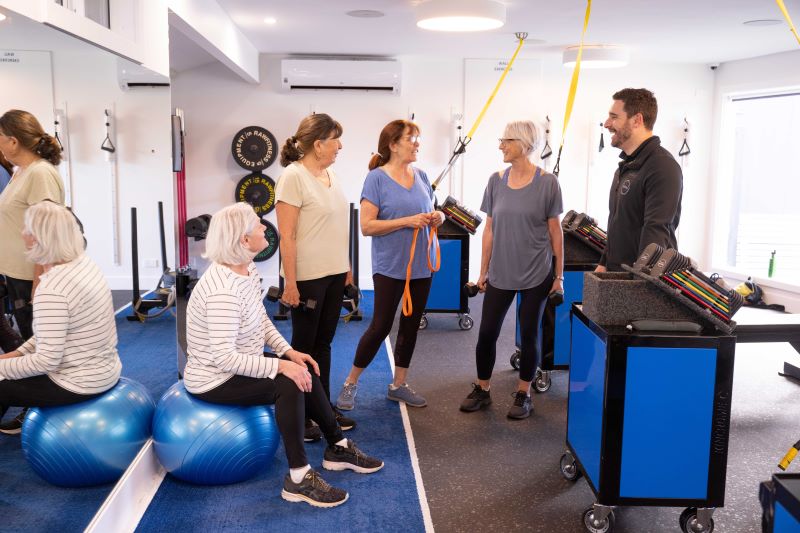
At Holistic Physio Fitness, we can assess your current capacity, explain what we are working on and build a program that progresses with you. We offer one-to-one Exercise Physiology and small supervised group classes in our Mona Vale gym on Sydney’s Northern Beaches.
Frequently Asked Questions
How often should people over 40 strength train?
The Australian guidelines recommend muscle-strengthening activity on at least two days per week. Your ideal frequency depends on your goals, experience, health, recovery and the rest of your activity.
Can I start strength training if I have back or knee pain?
Often, yes—but the exercises and starting load may need to be modified. An assessment can help identify a suitable entry point and whether further medical or physiotherapy input is needed.
Are machines or free weights better after 40?
Neither is universally better. Machines can provide stability and make some movements easier to learn, while free weights can offer flexibility and a different coordination challenge. A good program can use either or both.
How quickly will I notice results?
This varies. Some people notice improvements in confidence, technique and everyday tasks within the first several weeks, while changes in muscle size, body composition and bone health generally require longer-term consistency.
Is strength training more important than cardio after 40?
They provide overlapping but different benefits, so it is not an either-or decision. Most people benefit from combining resistance training with aerobic activity, mobility and balance work.
Build Strength for the Decades Ahead
The goal of strength training after 40 is not to compete with your younger self. It is to build the capacity you need now and protect the activities you want to keep doing in the future.
You do not need a perfect program or an extreme routine. You need an appropriate starting point, gradual progression and enough consistency to let your body adapt.
If pain, injury or uncertainty has been holding you back, our team can help. Contact Holistic Physio Fitness to book an Exercise Physiology assessment with me at our Mona Vale clinic and take the first step towards becoming stronger, more capable and more confident.
Patrick Hughes is an Exercise Physiologist at Holistic Physio Fitness. He has close to a decade of private-practice experience and a particular interest in musculoskeletal rehabilitation, chronic disease management, gym-based rehabilitation and strength and conditioning.
This article provides general information and does not replace individual medical or allied health advice. Seek professional assessment if you have concerning symptoms, a significant medical condition or uncertainty about starting exercise.
References
-
Australian Government Department of Health, Disability and Ageing. Recommendations for adults (18 to 64 years). Updated 3 June 2026. https://www.health.gov.au/topics/physical-activity/24-hour-movement-guidelines-for-all-australians/recommendations-for-adults-18-to-64-years
-
Currier BS, et al. American College of Sports Medicine Position Stand: Resistance Training Prescription for Muscle Function, Hypertrophy, and Physical Performance in Healthy Adults—An Overview of Reviews. Medicine & Science in Sports & Exercise. 2026. https://pubmed.ncbi.nlm.nih.gov/41843416/
-
Ferreira ML, et al. Physical activity improves strength, balance and endurance in adults aged 40–65 years: a systematic review. Journal of Physiotherapy. 2012;58(3):145–156. https://pubmed.ncbi.nlm.nih.gov/22884181/
-
Momma H, et al. Muscle-strengthening activities are associated with lower risk and mortality in major non-communicable diseases: a systematic review and meta-analysis of cohort studies. British Journal of Sports Medicine. 2022;56(13):755–763. https://bjsm.bmj.com/content/56/13/755
-
Raposo F, et al. Effects of exercise on knee osteoarthritis: a systematic review. Musculoskeletal Care. 2021;19(4):399–435. https://pubmed.ncbi.nlm.nih.gov/33666347/
-
Watson SL, et al. High-intensity resistance and impact training improves bone mineral density and physical function in postmenopausal women with osteopenia and osteoporosis: the LIFTMOR randomised controlled trial. Journal of Bone and Mineral Research. 2018;33(2):211–220. https://pubmed.ncbi.nlm.nih.gov/28975661/
SEE EXERCISE PHYSIOLOGY SERVICES AT HOLISTIC PHYSIO FITNESS MONA VALE HERE